Meerkats, also known as suricates, are small members of
the mongoose family that live in Africa. They live underground in colonies
(groups) of up to 25 animals. Meerkats stand up straight on their hind legs to
search for danger.
Suricate
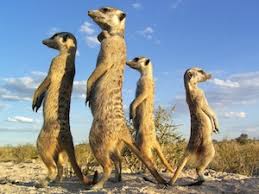
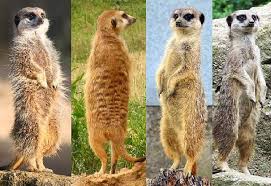 Suricates typically stand up straight on their hind legs
or even their toes to sniff the wind and search for attacking eagles and hawks.
They have excellent vision and are capable of making at least ten types of
sounds, including an alarm bark and alerting and warning calls to indicate air
or ground predators.
Suricates typically stand up straight on their hind legs
or even their toes to sniff the wind and search for attacking eagles and hawks.
They have excellent vision and are capable of making at least ten types of
sounds, including an alarm bark and alerting and warning calls to indicate air
or ground predators.
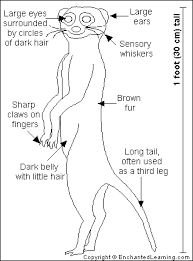
Suricate or Meerkat, also called slender-tailed meerkat or zenick,
small member of the mongoose family that inhabits the Kalahari Desert of
southern Africa. Suricates or meerkats are known for their upright posture and
highly sociable behavior.
Suricates typically live in dry, open areas and savannas.
Their range extends from southwestern Angola to South Africa, and includes
Botswana, Zimbabwe, Mozambique, and Namibia. These social animals live in
colonies, usually in desert places with sandy soil where they can dig elaborate
underground burrows.
Colonies can number up to 30 or 40 individuals, but
smaller groups are also common. Social hierarchies often exist in the packs,
with a dominant male and female breeding pair in a family group that includes
nonbreeders who help care for the young. Individuals in a colony usually
cooperate peaceably, sharing pup-rearing duties and taking turns standing guard
to watch for predators. However, recent research has found that female suricates
sometimes kill the young of other females to protect or advance the survival of
their own offspring.
Suricates measure about 25 to 35 cm (about 10 to 14 in) in
length, not including the tail, which is from 18 to 25 cm (7 to 10 in) long.
They are more slender than many mongooses. They have pointed snouts,
silvery-brown fur, and irregular dark stripes on the rump. Their faces are white
with dark markings on the ears and around the eyes. They have special flaps to
keep sand out of their ears when they dig. Unlike most mongooses, suricates have
four rather than five toes on each paw.
Suricates forage for food only during the daytime, eating
mainly insects and insect larvae, particularly beetles, but they prey as well on
spiders, scorpions, centipedes, and millipedes. They sometimes feed on small
vertebrates such as lizards, snakes, rodents, and birds, and on eggs and roots.
Predators that hunt suricates include jackals, servals, eagles, and hawks.
Snakes will eat suricate pups. When eagles or hawks are sighted, suricates will
hide in their burrows. Suricates often mob together to drive off ground
predators. The noisy, tightly packed swarm may create the illusion of a single
large animal.
Suricates typically have two to four young, which are
often born in the fall or early winter after a gestational period of about 11
weeks. Both females and males care for, groom, and guard their offspring.
Suricates are one of the few wild animals known to actively teach their young.
According to studies published in 2006, adults and older juveniles help pups
learn how to handle different prey items. Before the helpers give the prey to
younger pups, they will disable or kill the animal, and will remove poisonous
stingers from scorpions. Older pups are given live prey to subdue by themselves.
The helpers monitor the pups and encourage them by nudging the prey or will
retrieve live prey that escapes.
Because suricates can carry rabies, they have been hunted
or gassed in their burrows in areas where they pose a threat to humans. This has
not reduced their numbers significantly. In South Africa these affectionate and
easily tamed creatures are often kept as pets.
Suricates are commonly known as meerkats. However, two
other types of small African mongoose are called meerkats as well. The yellow
mongoose (Cynictis) is referred to as the thick-tailed meerkat or the red
meerkat—it lives in small groups, is active in daytime, and stands erect to
watch for predators. Selous's mongoose (Paracynictis) sometimes is called
the gray meerkat—it leads a more solitary life and is mainly nocturnal.
Scientific classification: The suricate is a member
of the mongoose family, Herpestidae, in the order Carnivora. It is classified as
Suricata suricatta.

No comments:
Post a Comment